Oxo Good Gripsã‚â® Chef's Precision Digital Instant Read
Download every bit PDF - 
A straightforward explanation of biodegradable vs. compostable vs. oxo-degradable plastics
As consumer demand for sustainable products grows, bioplastics —which tin can reduce our reliance on fossil fuels and decrease greenhouse emissions— volition become more prevalent. Production of bioplastics is expected to grow by equally much as 20% by 2022, and as it does, consumer understanding of bioplastics will need to abound with it.
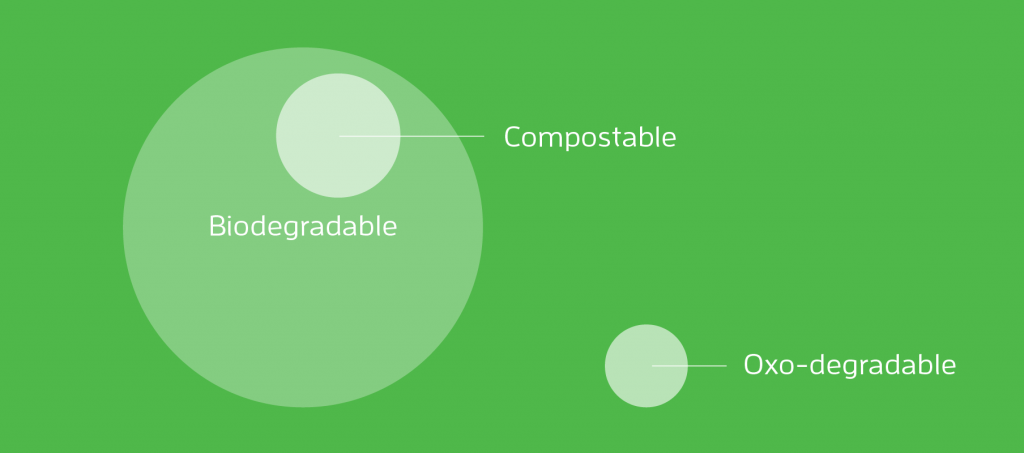
A major source of confusion is the deviation between three terms: Biodegradability, compostability and oxo-degradability. Although these terms are often used interchangeably, they are not synonymous. Confusion regarding mutual bioplastics terminology such as these, particularly where it concerns the disposal of bioplastic products, tin have dire consequences. Companies need to understand the distinctions between each category in order to accurately and honestly market place their products. And consumers demand to understand these terms in order to make educated purchasing decisions and properly dispose of bioplastic products at the end of use.
Agreement bioplastics: Bio-based vs. biodegradable
To understand these three terms (i.e., biodegradability, compostability and oxo-degradability), it is important commencement to clearly understand the definition of bioplastics. Bioplastics refer to a large family of plastics which are sourced from biomass at the beginning of their life (bio-based), metabolized into organic biomass at the finish of their life (biodegradable), or both.
Based on this, bioplastics can be broken down into three distinct classifications:
- Non-biodegradable and fully or partially bio-based (east.m., bio-based PET, bio-based PE, Terratek® SC or Terratek® WC).
- Biodegradable and petroleum-based (g., PCL).
- Both biodegradable and fully or partially bio-based (e.g., PLA or starch blends such every bit Terratek® BD).
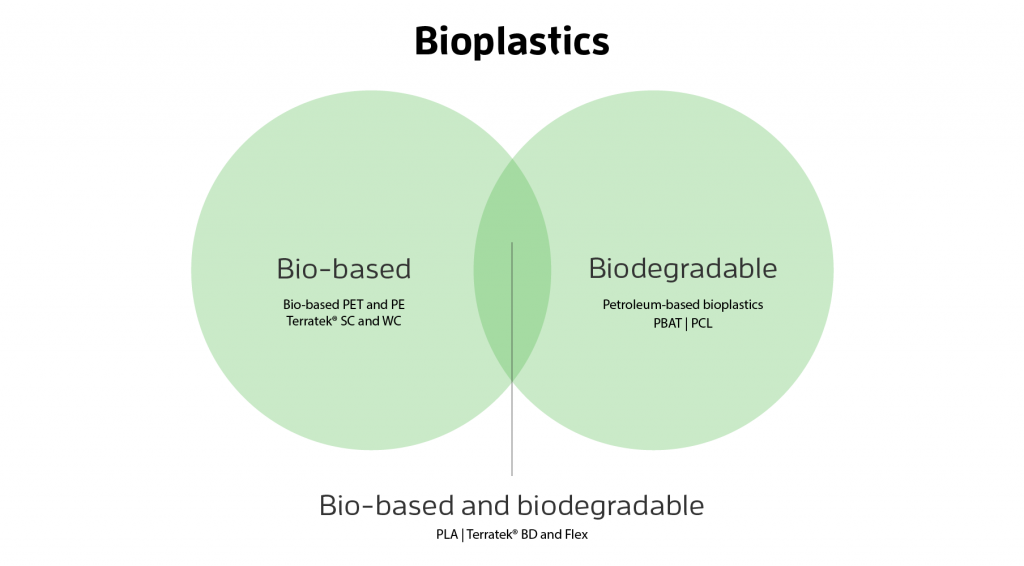
Biodegradable plastics are a relatively small subset of bioplastics which can be converted into water, carbon dioxide (CO2) and bio-mass over fourth dimension with the help of micro-organisms — this process is called biodegradation. And because the biodegradability of a plastic lies with the chemical backdrop of the polymer —and not the source of the feedstock— biodegradable plastics can exist either bio- or petroleum-based.
Biodegradable vs. compostable vs. oxo-degradable plastics
Nearly every material volition biodegrade, given enough time. But the length of the biodegradation process is highly dependent on environmental parameters such as humidity and temperature, which is why claiming that a plastic is "biodegradable" without any further context (i.e., in what timeframe and nether what environmental conditions) is misleading to consumers.
Reputable companies volition often make more specific claims, primarily certifying that their bioplastics are compostable. Compostable plastics are a subset of biodegradable plastics, defined past the standard weather condition and timeframe under which they will biodegrade. All compostable plastics are biodegradable, but not all biodegradable plastics would exist considered compostable.
Certified compostable: A more specific claim of biodegradability
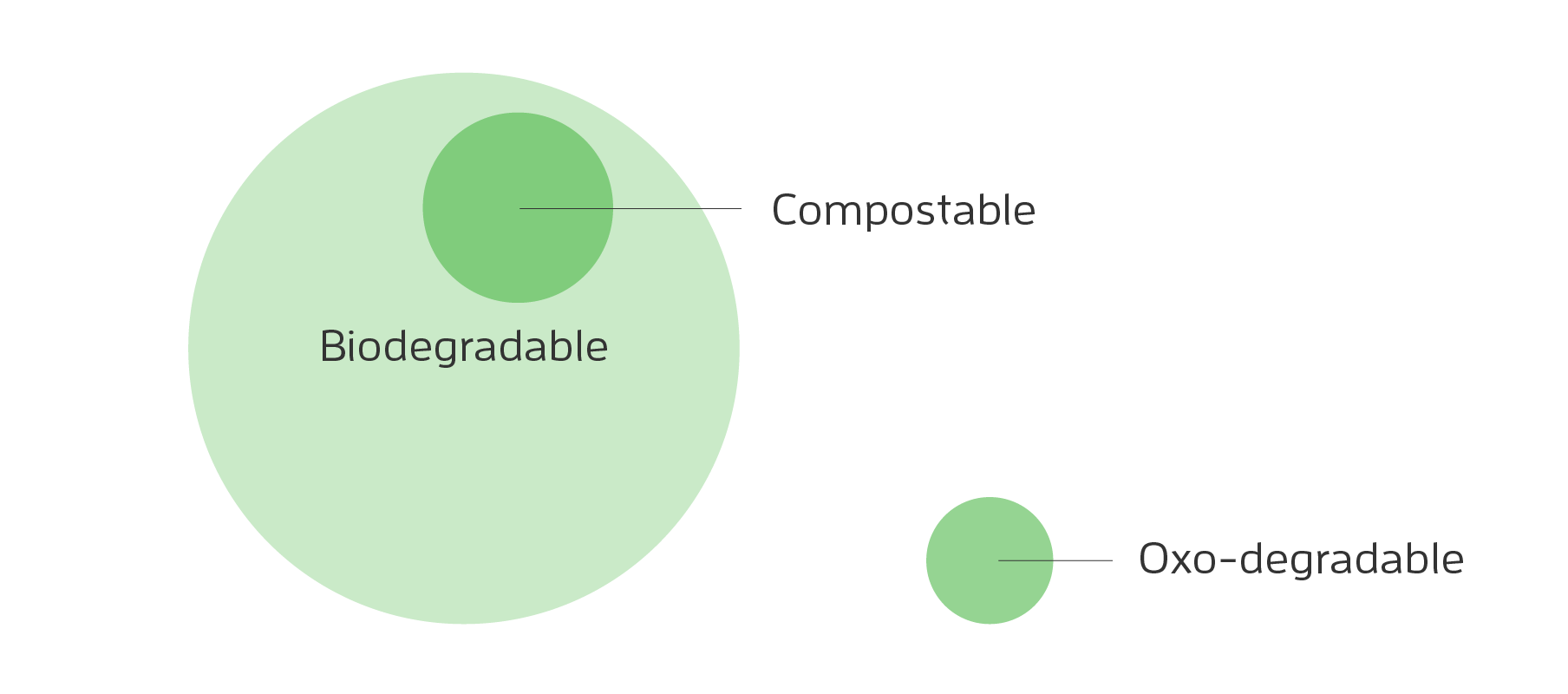
Compostable plastics are those plastics which accept been tested and certified past a third political party to adhere to international standards such every bit ASTM D6400 (in the U.S.) or EN 13432 (in Europe) for biodegradation in an industrial composting facility environs.
Materials certified co-ordinate to ASTM D6400 or EN 13432 will disintegrate within 12 weeks and biodegrade at least ninety% within 180 days in a municipal or industrial composting facility. Approximately 10% of solid material will be left at the finish of the half dozen-month-long process in the grade of valuable compost, or biomass and h2o. These standards also ensure that the leftover compost will be gratis of toxins, and so the compost will not cause impairment when the facility sells it for gardening or agricultural applications.
Unless otherwise denoted, certified compostable products must exist disposed of in a designated municipal composting facility, non at dwelling house. Many certified compostable materials require the higher temperatures of industrial settings to biodegrade quickly plenty, or in some cases at all.
Few areas in the U.S. accept curbside collection for industrial composting, which is why certified compostable products are all-time utilized in closed systems such as amusement parks, stadiums and schools, where compostable and organic waste product is carefully monitored and controlled to ensure proper disposal in an industrial composting facility. San Francisco International Airport and Safeco Field in Seattle are two good examples of organizations using composting equally a ways of reducing their carbon footprint and diverting organic waste product from landfills.
A quick note on oxo-degradable plastics
While often confused with biodegradable plastics, oxo-degradables are a category unto themselves. They are neither a bioplastic nor a biodegradable plastic, but rather a conventional plastic mixed with an additive in lodge to imitate biodegredation. Oxo-degradable plastics apace fragment into smaller and smaller pieces, chosen microplastics, but don't interruption downwards at the molecular or polymer level like biodegradable and compostable plastics. The resulting microplastics are left in the surround indefinitely until they eventually fully pause down.
The importance of conspicuously and accurately labeling plastic products
As bioplastics go on to gain marketplace share in the coming years, being clear about the ecology benefits in product and material marketing is imperative. Looking to the Federal Merchandise Commission'south (FTC) Light-green Guides is a good place to start. The Green Guides outline best practices for clearly labeling and marketing green products to ensure the expectations of the consumer align.
Not but will transparency allow consumers to brand smarter purchasing decisions, but it will ensure bioplastics are tending of through the proper channels. Ultimately, better terminate-of-life disposal of bioplastics strengthens their environmental value proposition of diverting organic waste from landfills, reducing greenhouse emissions and ensuring the sustainable consumption of resources.
At Light-green Dot, nosotros specialize in alloying biodegradable polymers to run across customer-specific function performance requirements. And we always aim to be direct and transparent when information technology comes to our bioplastic material options. It's why, whenever we claim a textile is "biodegradable," we are referring to the compostability standards set forth in ASTM D6400 and EN 13432. That way, everyone is on the same page.
To learn more, check out our guide to creating sustainable plastics without sacrificing quality or cost. You'll learn how to meet your sustainability —and performance— requirements simultaneously.
Source: https://www.greendotbioplastics.com/biodegradable-vs-compostable-vs-oxo-degradable-plastics-a-straightforward-explanation/
0 Response to "Oxo Good Gripsã‚â® Chef's Precision Digital Instant Read"
Post a Comment