The National Gallery of Art Is a Beautiful Example of Architecture
 | |
 | |
| Location in Washington, D.C. Show map of Washington, D.C. National Gallery of Art (the U.s.) Show map of the Usa | |
| Established | 1937 (1937) |
|---|---|
| Location | National Mall between 3rd and 9th Streets at Constitution Avenue NW, Washington, DC, 20565, National Mall, Washington, D.C. |
| Coordinates | 38°53′29″N 77°01′12″W / 38.89139°Due north 77.02000°Due west / 38.89139; -77.02000 Coordinates: 38°53′29″North 77°01′12″Westward / 38.89139°N 77.02000°W / 38.89139; -77.02000 |
| Collection size | 75,000 prints |
| Visitors | ane,704,606 (2021) - Ranked 6th globally[one] |
| Managing director | Kaywin Feldman |
| President | Mitchell Rales |
| Chairperson | Sharon Rockefeller |
| Public transit admission |  Washington Metro: Washington Metro:  Judiciary Square Judiciary Square   archives archives    Smithsonian Smithsonian  50'Enfant 50'Enfant Metrobus: 4th Street and seventh Street NW DC Circulator: 4th Street and Madison Bulldoze; ninth Street and Constitution Artery NW |
| Website | nga.gov |


The National Gallery of Art, and its fastened Sculpture Garden, is a national art museum in Washington, D.C., United States, located on the National Mall, between 3rd and 9th Streets, at Constitution Avenue NW. Open to the public and gratuitous of charge, the museum was privately established in 1937 for the American people past a joint resolution of the Usa Congress. Andrew W. Mellon donated a substantial art collection and funds for construction. The cadre collection includes major works of art donated past Paul Mellon, Ailsa Mellon Bruce, Lessing J. Rosenwald, Samuel Henry Kress, Rush Harrison Kress, Peter Arrell Browne Widener, Joseph E. Widener, and Chester Dale. The Gallery's drove of paintings, drawings, prints, photographs, sculpture, medals, and decorative arts traces the development of Western Art from the Middle Ages to the nowadays, including the only painting past Leonardo da Vinci in the Americas and the largest mobile created by Alexander Calder.
The Gallery's campus includes the original neoclassical West Building designed by John Russell Pope, which is linked underground to the modernistic East Building, designed by I. M. Pei, and the half-dozen.1-acre (25,000 mtwo) Sculpture Garden. The Gallery often presents temporary special exhibitions spanning the globe and the history of art. Information technology is one of the largest museums in North America.
For the latitude, telescopic, and magnitude of its collections, the National Gallery is widely considered to be one of the greatest museums in the United States of America, often ranking aslope the Metropolitan Museum of Art and Museum of Modern Art in New York City, the Fine art Institute of Chicago in Chicago, Illinois, and the Museum of Fine Arts in Boston, Massachusetts. Of the top three fine art museums in the United States past almanac visitors, it is the only one that has no admission fee. in 2021 it attracted 1,704,606 visitors, and ranked fifth on the listing of nearly visited fine art museums in the world.[two]
History [edit]
Origins [edit]
Andrew W. Mellon, Pittsburgh banker and Treasury Secretary from 1921 until 1932, began gathering a private collection of old master paintings and sculptures during World War I. During the belatedly 1920s, Mellon decided to direct his collecting efforts towards the establishment of a new national gallery for the United States.
In 1930, partly for tax reasons, Mellon formed the A. W. Mellon Educational and Charitable Trust, which was to be the legal owner of works intended for the gallery. In 1930–1931, the Trust fabricated its kickoff major acquisition, 21 paintings from the Hermitage Museum in St. Petersburg as part of the Soviet auction of Hermitage paintings, including such masterpieces as Raphael's Alba Madonna, Titian's Venus with a Mirror, and Jan van Eyck's Annunciation.
In 1929 Mellon had initiated contact with the recently appointed Secretary of the Smithsonian Institution, Charles Greeley Abbot. Mellon was appointed in 1931 as a Commissioner of the Establishment'southward National Gallery of Art. When the director of the Gallery retired, Mellon asked Abbot not to engage a successor, as he proposed to endow a new building with funds for expansion of the collections.
However, Mellon's trial for revenue enhancement evasion, centering on the Trust and the Hermitage paintings, caused the plan to be modified. In 1935, Mellon announced in The Washington Star his intention to establish a new gallery for old masters, separate from the Smithsonian. When asked by Abbot, he explained that the project was in the hands of the Trust and that its decisions were partly dependent on "the attitude of the Government towards the gift".
In January 1937, Mellon formally offered to create the new Gallery. On his altogether, 24 March 1937, an Deed of Congress accepted the collection and building funds (provided through the Trust), and approved the structure of a museum on the National Mall.
The new gallery was to be effectively cocky-governing, not controlled by the Smithsonian, but took the onetime proper name "National Gallery of Fine art" while the Smithsonian's gallery would be renamed the "National Collection of Fine Arts" (now the Smithsonian American Art Museum).[3] [iv] [five]
Construction and subsequently history [edit]
The museum stands on the former site of the Baltimore and Potomac Railroad Station, where in 1881 a disgruntled office seeker, Charles Guiteau, shot President James Garfield (see James A. Garfield assassination).[6] The station was demolished in 1908 because information technology did not adjust to the McMillan Program for the Mall. In 1918, temporary war buildings were constructed on the site; these were demolished by 1921 to construct the foundation of the George Washington Memorial Building, which was never completed. The site was then reassigned to the new National Gallery of Art.[7]
Designed by architect John Russell Pope, the new construction was completed and accepted by President Franklin D. Roosevelt on behalf of the American people on March 17, 1941. At the time of its inception it was the largest marble structure in the globe. Neither Mellon nor Pope lived to meet the museum completed; both died in late August 1937, only two months afterward excavation had begun.[6]
Equally anticipated by Mellon, the creation of the National Gallery encouraged the donation of other substantial art collections by a number of individual donors. Founding benefactors included such individuals every bit Paul Mellon, Samuel H. Kress, Rush H. Kress, Ailsa Mellon Bruce, Chester Dale, Joseph Widener, Lessing J. Rosenwald and Edgar William and Bernice Chrysler Garbisch.
The Gallery's Due east Building was constructed in the 1970s on much of the remaining land left over from the original congressional action. Andrew Mellon'due south children, Paul Mellon and Ailsa Mellon Bruce, funded the building. Designed by architect I. M. Pei, the gimmicky structure was completed in 1978 and was opened on June 1 of that twelvemonth by President Jimmy Carter. The new building was built to business firm the Museum's collection of modernistic paintings, drawings, sculptures, and prints, too as study and research centers and offices. The design received a National Honor Laurels from the American Institute of Architects in 1981.
The final addition to the circuitous is the National Gallery of Art Sculpture Garden. Completed and opened to the public on May 23, 1999, the location provides an outdoor setting for exhibiting a number of big pieces from the Museum'due south contemporary sculpture collection.
In 2011, an extensive refurbishment and renovation of the French galleries were undertaken. Every bit part of the celebration of the reopening of this fly, organist Alexander Frey performed 4 sold-out recitals of music of French republic in i weekend in the French Gallery.
Operations [edit]
The National Gallery of Art is supported through a private-public partnership. The U.s.a. federal government provides funds, through almanac appropriations, to support the museum'southward operations and maintenance. All artwork, as well as special programs, are provided through individual donations and funds.[8] The museum is not part of the Smithsonian Establishment.
Noted directors of the National Gallery take included David Due east. Finley, Jr. (1938-1956), John Walker (1956–1968), and J. Carter Brown (1968–1993). Earl A. "Rusty" Powell III was named director in 1993. In March 2019 he was succeeded by Kaywin Feldman, past director and president of the Minneapolis Constitute of Art.[9] [10] The museum hired Evelyn Carmen Ramos, the get-go adult female and the showtime person of color to be the chief curatorial and conservation officeholder, in 2021.[eleven]
The president of the museum is billionaire businessman Mitchell Rales and its chairperson is Sharon Rockefeller.[12]
Entry to both buildings of the National Gallery of Art is free of charge. The museum is open daily from 10 a.m. – 5 p.m. It is airtight on December 25 and January 1.[13]
During the COVID-19 pandemic, the National Gallery was largely closed to the public. Nevertheless, visitors were able to schedule appointments to access the due west building in small numbers.[fourteen]
Compages [edit]

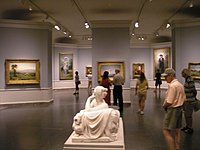
Exhibitions in the West Building

Exhibitions in the Eastward Building

Walkway to W Building and Cascade Buffet in National Gallery of Art, Washington.D.C.
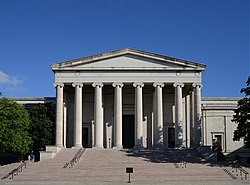
The museum comprises two buildings: the Westward Edifice (1941) and the East Edifice (1978) linked by an underground passage. The West Building, composed of pinkish Tennessee marble, was designed in 1937 by architect John Russell Pope in a neoclassical style (every bit is Pope'southward other notable building in Washington, D.C., the Jefferson Memorial). Designed in the form of an elongated H, the edifice is centered on a domed rotunda modeled on the interior of the Pantheon in Rome. Extending east and west from the rotunda, a pair of skylit sculpture halls provide its main circulation spine. Bright garden courts provide a counterpoint to the long chief axis of the building.

Dome of West Building, an archway to permanent Renaissance Art collections

Indoor garden court with paired Ionic columns and symmetrical planting beds. August 2021.
The West Building has an extensive collection of paintings and sculptures past European masters from the medieval period through the late 19th century, likewise every bit pre-20th century works by American artists. Highlights of the drove include many paintings by Jan Vermeer, Rembrandt van Rijn, Claude Monet, Vincent van Gogh, and Leonardo da Vinci.
In contrast, the pattern of the Eastward Building, past architect I. G. Pei, is geometrical, dividing the trapezoidal shape of the site into ii triangles: ane contains public galleries, and the other houses a library, offices, and a study eye. The triangles establish a motif that is echoed throughout the building, realized in every dimension.
The E Building's central feature is a loftier atrium designed as an open up interior court that is enclosed past a sculptural space spanning xvi,000 sq ft (1,500 m2). The atrium is centered on the same centrality that forms the circulation spine for the West Building and is synthetic in the aforementioned Tennessee marble.[15]
Notwithstanding, in 2005 the joints attaching the marble panels to the walls began to show signs of strain, creating a run a risk that panels might fall onto visitors below. In 2008, NGA officials decided that it had go necessary to remove and reinstall all of the panels. The renovation was completed in 2016.[sixteen]
The East Building focuses on modern and contemporary fine art, with a collection including works by Pablo Picasso, Henri Matisse, Jackson Pollock, Andy Warhol, Roy Lichtenstein, Alexander Calder, a 1977 mural past Robert Motherwell and works by many other artists. The East Building also contains the main offices of the NGA and a large research facility, Centre for Advanced Study in the Visual Arts (CASVA). Amongst the highlights of the Due east Edifice in 2012 was an exhibition of Barnett Newman's The Stations of the Cantankerous serial of fourteen blackness and white paintings (1958–66).[17] Newman painted them later he had recovered from a centre assail; they are commonly regarded as the peak of his achievement.[ citation needed ] The series has also been seen as a memorial to the victims of the Holocaust.[18]
The two buildings are connected by a walkway beneath 4th street, called "the Concourse" on the museum's map. In 2008, the National Gallery of Fine art commissioned American creative person Leo Villareal to transform the Concourse into an artistic installation. Today, Multiverse is the largest and nearly circuitous calorie-free sculpture by Villareal featuring approximately 41,000 reckoner-programmed LED nodes that run through channels along the entire 200 ft (61 m)-long space.[nineteen] The concourse besides includes the food court and a souvenir shop.
The concluding element of the National Gallery of Art complex, the Sculpture Garden was completed in 1999 afterwards more than thirty years of planning. To the west of the West Building, on the contrary side of Seventh Street, the 6.1 acres (ii.5 ha) Sculpture Garden was designed by landscape architect Laurie Olin[20] as an outdoor gallery for monumental modern sculpture.
The Sculpture Garden contains plantings of Native American species of canopy and flowering trees, shrubs, basis covers, and perennials. A circular reflecting puddle and fountain form the center of its design, which arching pathways of granite and crushed stone complement. (The pool becomes an ice-skating rink during the winter.) The sculptures exhibited in the surrounding landscaped area include pieces by Marc Chagall, David Smith, Marking Di Suvero, Roy Lichtenstein, Sol LeWitt, Tony Smith, Roxy Paine, Joan Miró, Louise Bourgeois, and Hector Guimard.[21]

The lobby of National gallery of Fine art Eastward Building

Taken at the exterior wall of National gallery of Fine art Due east Building
Renovations [edit]
The NGA'due south W Building was renovated from 2007 to 2009. Although some galleries airtight for periods of time, others remained open up.[22]
After congressional testimony that the East Building suffered from "systematic structural failures", NGA adopted a Master Renovations Plan in 1999. This programme established the timeline for closing the edifice, and planned for the renovation of the electronic security systems, elevators, and HVAC.[23] Infinite betwixt the ceilings of existing galleries and the building'south skylights (which was never completed when the edifice was constructed in 1978)[23] would be renovated into two, 23 ft (7.0 m) high, hexagonal Belfry Galleries. The galleries would have a combined 12,260 sq ft (one,139 m2) of space and volition be lit past skylights. A rooftop sculpture garden would too be added. NGA officials said that the Belfry Galleries would probably house modernistic art, and the creation of a distinct "Rothko Room" was possible.
Beginning in 2011, NGA undertook an $85 1000000 restoration of the Eastward Building's façade.[24] The E Building is clad in three in (7.6 cm) thick pink marble panels. The panels are held about ii in (5.ane cm) away from the wall by stainless steel anchors. Gravity holds the console in the bottom anchors (which are placed at each corner), while "button caput" anchors (stainless steel posts with large, flat heads) at the summit corners continue the console upright. Mortar was used on the gravity anchors to level the stones. Joints of flexible colored neoprene were placed between the panels. This system was designed to permit each panel to hang independent of its neighbors, and NGA officials say they are not enlightened of whatsoever other console system like information technology.
However, many panels were accidentally mortared together. Seasonal heating and cooling of the façade, infiltration of moisture, and shrinkage of the edifice's structural concrete by 2 in (5.1 cm) over fourth dimension caused all-encompassing damage to the façade. In 2005, regular maintenance showed that some panels were cracked or significantly damaged, while others leaned by more one in (ii.five cm) out from the edifice (threatening to fall).
The NGA hired the structural engineering firm Robert Silman Associates to determine the crusade of the problem.[25] Although the Gallery began raising private funds to fix the issue,[25] eventually federal funding was used to repair the building.[24] In 2012, the NGA chose a joint venture, Balfour Beatty/Smoot, to consummate the repairs. Anodized aluminum anchors replaced the stainless steel ones, and the top corner anchors were moved to the middle of the top edge of each stone. The neoprene joints were removed and new colored silicone gaskets installed, and leveling screws rather than mortar used to go on the panels square. Work began in Nov 2011,[25] and originally was scheduled to stop in 2014.[24] By February 2012, nevertheless, the contractor said work on the façade would terminate in tardily 2013, and site restoration would take identify in 2014.[25] The East Building remained open throughout the projection.[22]
In March 2013, the National Gallery of Art announced a $68.4 million renovation to the East Building. This included $38.iv meg to refurbish the interior mechanical plant of the structure,[23] and $30 million to create new exhibition space.[22] Because the angular interior space of the Due east Building fabricated information technology impossible to close off galleries,[23] the renovation required all simply the atrium and offices to close by Dec 2013. The structure remained closed for three years. The architectural business firm of Hartman-Cox oversaw both aspects of the renovation.[23]
A group of benefactors — which included Victoria and Roger Sant, Mitchell and Emily Rales, and David Rubenstein — privately financed the renovation. The Washington Post reported that the donation was one of the largest the NGA had received in a decade.[22] NGA staff said that they would use the closure to conserve artwork, plan purchases, and develop exhibitions. Plans for renovating conservation, construction, exhibition prep, groundskeeping, part, storage, and other internal facilities were likewise gear up, but would non be implemented for many years.[23] [26]
Buildings [edit]
-

The West Building soon after structure, looking southeast from the National Mall
-

Due north face of the West Building, with the west side of the Eastward Building and the United States Capitol in background
-

South face of the West Edifice (2014)
-

Rotunda of the West Building beneath dome (2004)
-

Oculus of the West Building dome (2008)
-
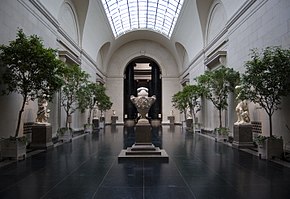
Due west Building sculpture gallery (2007)
-

W Building garden court (2010)
-
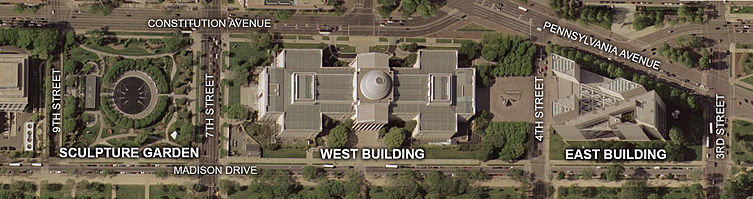
Satellite image of National Gallery of Art grounds and surrounding streets (2002)
-

Center of West Building plaza, looking w towards Due west Building (2010)
-
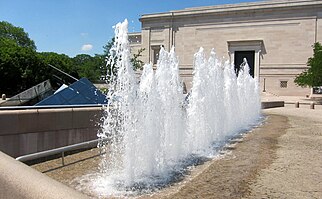
Fountain in West Building plaza (2010)
-
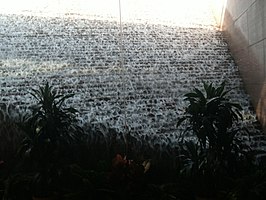
View of fountain from concourse below West Building plaza (2013)
-

Centre of W Building plaza, looking east towards entrance of East Building (2000)
-

S face of Due east Building, looking northwest from southeast corner (2010)
-

Southwest corner of East Edifice, looking east (2007)
-

Southwest corner of Due east Building during renovation, looking northeast (2014)
-

E Building atrium (2007)
-
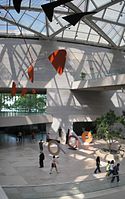
Due east Building atrium (2007)
Drove [edit]

Gerard van Honthorst's monumental 1623 masterwork, The Concert, was acquired by the NGA in 2013 and went on brandish for the starting time time in 218 years.
The NGA's collection galleries and Sculpture Garden brandish European and American paintings, sculpture, works on newspaper, photographs, and decorative arts. Paintings in the permanent collection engagement from the Middle Ages to the present. The Italian Renaissance collection includes two panels from Duccio's Maesta, the tondo of the Admiration of the Magi by Fra Angelico and Filippo Lippi, a Botticelli work on the same subject, Giorgione'south Allendale Nativity, Giovanni Bellini'due south The Feast of the Gods, Ginevra de' Benci (the only painting past Leonardo da Vinci in the Americas) and groups of works by Titian and Raphael.
The collections include paintings by many European masters, including a version of Saint Martin and the Beggar, past El Greco, and works past Matthias Grünewald, Cranach the Elder, Rogier van der Weyden, Albrecht Dürer, Frans Hals, Rembrandt, Johannes Vermeer, Francisco Goya, Jean Auguste Dominique Ingres, and Eugène Delacroix, amid others. The collection of sculpture and decorative arts includes such works as the Chalice of Abbot Suger of St-Denis and a collection of work past Auguste Rodin and Edgar Degas. Other highlights of the permanent collection include the 2nd of the two original sets of Thomas Cole's series of paintings titled The Voyage of Life, (the first set is at the Munson-Williams-Proctor Arts Institute in Utica, New York) and the original version of Watson and the Shark by John Singleton Copley (two other versions are in the Museum of Fine Arts, Boston and the Detroit Institute of Arts).
The National Gallery'south print drove comprises 75,000 prints, in improver to rare illustrated books. It includes collections of works by Albrecht Dürer, Rembrandt, Giovanni Battista Piranesi, William Blake, Mary Cassatt, Edvard Munch, Jasper Johns, and Robert Rauschenberg. The drove began with 400 prints donated by five collectors in 1941. In 1942, Joseph E. Widener donated his entire collection of nearly 2,000 works. In 1943, Lessing Rosenwald donated his collection of viii,000 old principal and modern prints; between 1943 and 1979, he donated almost fourteen,000 more than works. In 2008, Dave and Reba White Williams donated their drove of more than 5,200 American prints.[27]
In 2013, the NGA purchased from a private French collection Gerard van Honthorst's 1623 painting, The Concert, which had not been publicly viewed since 1795. After initially displaying the 1.23 by 2.06 m (4.0 by six.8 ft) The Concert in a special installation in the W Building, the NGA moved the painting to a permanent display in the museum's Dutch and Flemish galleries.[28] Art experts estimated the sale price of The Concert at $xx million, though the NGA did not reveal the amount that it had paid.[29]
Highlights of the collection [edit]

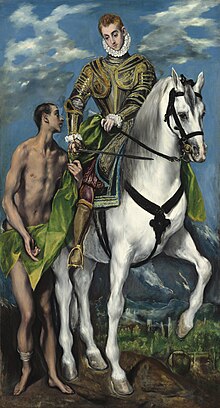


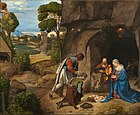
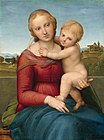

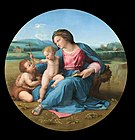











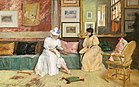
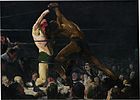
Selected highlights from the American collection [edit]


-

-

-

-

-

-

-

-

Thomas Cole, A View of the Mountain Pass Called the Notch of the White Mountains (Crawford Notch), 1839
-

-

-

-

-
-
Come across besides [edit]
- Collections of the National Gallery of Art
- List of original Hermitage paintings in the National Gallery of Fine art
References [edit]
- ^ The Art Newspaper Review, March 28,2022
- ^ The Art Newspaper annual museum visitor survey, published March 28,2022
- ^ Fink, Lois Marie "A History of the Smithsonian American Fine art Museum", Academy of Massachusetts Press (2007) ISBN 978-1-55849-616-3, chapter three
- ^ National Gallery of Art website: full general introduction Archived December eight, 2006, at the Wayback Machine
- ^ National Gallery of Art website: chronology Archived April 7, 2010, at the Wayback Machine
- ^ a b "National Gallery of Art, Westward Building". American Architecture. Archived from the original on half dozen Oct 2011. Retrieved 2 October 2011.
- ^ "Cultural Mural Inventory: The Mall (Part 2)" (PDF). U.S. National Park Service. 2006. pp. 49, 53, 72. Retrieved 2021-02-22 .
{{cite spider web}}: CS1 maint: url-status (link) - ^ "Major Giving FAQS". www.nga.gov . Retrieved 2022-04-10 .
- ^ Kerr, Euan, "Mia'southward director will leave to head National Gallery", Minnesota Public Radio News, December xi, 2018.
- ^ McGlone, Peggy, "The National Gallery of Art will have a female person manager for the start time in its history", The Washington Mail service, December 11, 2018.
- ^ Greenberger, Alex (2021-05-xiii). "Latinx Art Expert E. Carmen Ramos Named Chief Curator of National Gallery of Fine art". ARTnews.com . Retrieved 2021-08-03 .
- ^ Selvin, Claire (2019-09-27). "National Gallery of Art Names Darren Walker Trustee, Mitchell Rales Appointed President". ARTnews . Retrieved 2019-09-28 .
- ^ "National Gallery of Fine art". Maps and Hours. 2016-01-12. Archived from the original on 2016-01-03.
- ^ "Degas at the Opéra". National Gallery of Fine art. 2020-08-25.
- ^ NGA.gov Archived October three, 2009, at the Wayback Machine
- ^ Leigh, Catesby (December 8, 2009). "An Ultramodern Building Shows Signs of Age". The Wall Street Journal. Archived from the original on March 11, 2016.
- ^ "In The Tower: Barnett Newman". www.nga.gov. Archived from the original on 1 February 2015. Retrieved 22 September 2014.
- ^ Menachem Wecker (August 1, 2012). "His Cross To Bear. Barnett Newman Dealt With Suffering in 'Zips'". The Jewish Daily Forward. Archived from the original on February four, 2013. Retrieved August eight, 2012.
- ^ "Leo Villareal: Multiverse". www.nga.gov.
- ^ "About the Gallery". world wide web.nga.gov. Archived from the original on 22 September 2014. Retrieved 22 September 2014.
- ^ "Visit: Sculpture Garden". www.nga.gov. Archived from the original on 26 September 2014. Retrieved 22 September 2014.
- ^ a b c d Boyle, Katherine and Parker, Lonnae O'Neal. "National Gallery of Fine art Announces $xxx Million Renovation to East Building." Washington Post. March 12, 2013. Archived Apr 21, 2016, at the Wayback Machine Accessed 2013-03-thirteen.
- ^ a b c d due east f Boyle, Katherine. "National Gallery Sees Long-Term Benefit in Long Closing of East Building." Washington Mail service. March 13, 2013. Archived January half dozen, 2018, at the Wayback Machine Accessed 2013-03-22.
- ^ a b c Kelly, John. "Why National Gallery's Eastward Building Shed Its Pinkish Marble Pare." Washington Post. February 21, 2012. Archived January 6, 2018, at the Wayback Machine Accessed 2013-03-thirteen.
- ^ a b c d Dietsch, Deborah K. "National Gallery of Art'southward Famed East Edifice Gets a Facelift." Washington Business Journal. February three, 2012. Archived Oct xviii, 2015, at the Wayback Machine Accessed 2013-03-13.
- ^ "The CIVITAS Chronicles". traditional-edifice.com. Archived from the original on 2015-03-23.
- ^ "Prints". Nga.gov. 2013-06-19. Archived from the original on 2013-12-21. Retrieved 2013-12-22 .
- ^ Boyle, Katherine. "National Gallery Acquires 'The Concert' by Dutch Aureate Age Painter Honthorst." Washington Post. November 22, 2013. Archived August 29, 2017, at the Wayback Auto Accessed 2013-eleven-22.
- ^ Vogel, Carol "National Gallery Acquires a van Honthorst Masterwork." New York Times. November 21, 2013. Archived February 24, 2017, at the Wayback Machine Accessed 2013-11-22.
- ^ "Provenance". Nga.gov. Archived from the original on 2009-05-07. Retrieved 2013-12-22 .
Farther reading [edit]
- David Cannadine, Mellon: An American Life, Knopf, 2006, ISBN 0-679-45032-vii
- Neil Harris, Capital Culture: J. Carter Brown, the National Gallery of Art, and the Reinvention of the Museum Experience, University of Chicago Printing, 2013, ISBN 9780226067704
- Andrew Kelly, Kentucky by Design: The Decorative Arts, American Civilization, and the Index of American Design, University Press of Kentucky, 2015. ISBN 978-0-8131-5567-viii
- "The National Gallery of Art, Washington", special number of Connaissance des Arts, Société Français de Promotion Artistique (2000) ISSN 1242-9198
External links [edit]
- Official website

- NGA Collection
- Section of Image Collections, National Gallery of Fine art Library
- Middle for Advanced Study in the Visual Arts
0 Response to "The National Gallery of Art Is a Beautiful Example of Architecture"
Post a Comment